Delivering Negative Feedback to a High-Performing Sales Rep
Protect your best reps by delivering criticism the right way.

Sales performance data shows roughly 84% of individual sales reps missed quota last year, with a small cluster of top producers carrying revenue for entire teams. That concentration changes the math on feedback. Mishandle one conversation with a top performer, and the manager isn't correcting an underperformer. He's risking the output of an entire roster.
How top performers are wired differently as feedback recipients
Confidence, a competitive sense of identity, comfort operating with minimal oversight: these are the traits that make a rep exceptional, and they're the same traits that make criticism land differently on him than it does on an average performer. Confidence built on a track record doesn't get suspended the moment a manager walks in with concerns. It gets activated, often as a defense mechanism.
Research ties negative feedback to identity threat and emotional exhaustion. The brain doesn't file it as neutral data to be sorted and used. It files it as a threat to be countered, and the rep's first instinct is rarely "how do I fix this." It's "how do I protect myself."
A finding reported by a research news outlet cuts against the usual assumption that self-aware people handle criticism better. Wanting to grow and being able to absorb a hard message in the moment turn out to be two separate skills. Self-image on the line means that intellectual openness to feedback buys no immunity from the sting of hearing it.
The riskiest version of this appears in reps who've fused identity with numbers. For someone in that position, a comment about a missed step in the sales process doesn't register as feedback on a behavior. It registers as a verdict on who he is, and a verdict is a much harder thing to walk back than a note on technique.
The feedback gap that already exists before the hard conversation starts
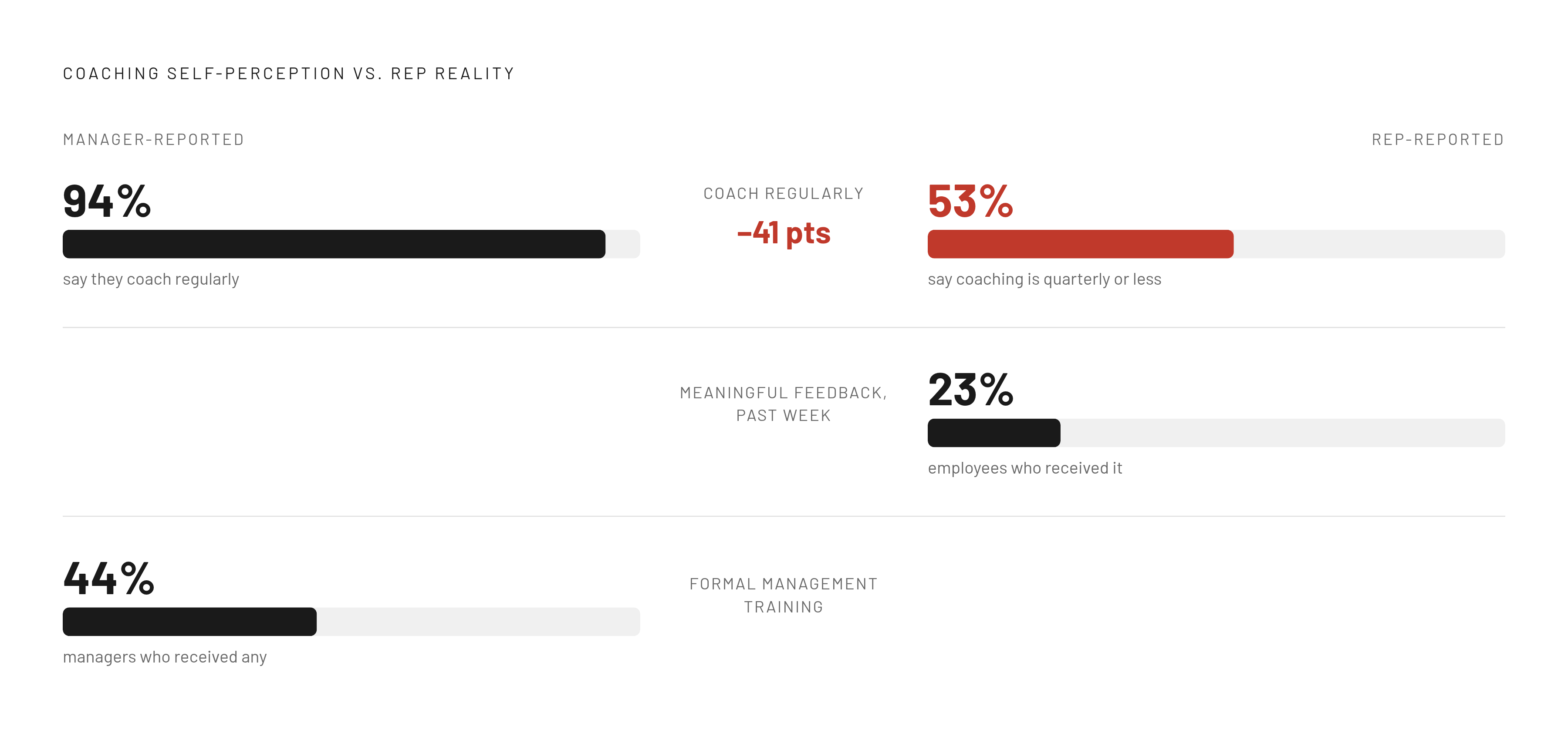
Most managers aren't just bad at the hard conversation. They've skipped most of the easy ones too. Only 23% of employees worldwide report getting meaningful feedback in the past week. Three-quarters of teams are running without a reliable read on their own performance until something forces the issue.
The gap between manager self-perception and rep experience is stark, and it's a gap most managers don't know exists. Ninety-four percent of managers say they coach their people regularly. Fifty-three percent of sellers say coaching happens quarterly or less, and 37% say they rarely or never get anything personalized. Someone is wrong about what's happening in these one-on-ones, and it isn't the reps, because the rep is the one sitting across the desk with nothing to show for the last quarter's worth of meetings.
Part of the explanation is structural. Only 44% of managers worldwide have received any formal training in how to manage people. More than half the people responsible for delivering feedback were never taught how to do it. They were promoted into the role and left to improvise. It tracks, then, that 95% of managers say they're unhappy with the performance management systems they're stuck using. The infrastructure for feedback is thin almost everywhere, and it's thinnest exactly where the stakes are highest: with the reps whose output the team can least afford to lose.
What most managers do wrong when they try
The compliment sandwich is the default move for a manager who knows a conversation is going to sting and wants to soften it, and it's the wrong move. Research has found the technique largely doesn't work: employees read the praise as an insincere buffer, tune out the middle where the actual critique lives, and walk away remembering the compliments, not the correction. The meat gets thrown out along with the bread around it.
The social cost runs deeper than a message that fails to land. Research has found that employees who received critical appraisals from colleagues later avoided those colleagues, even when the criticism was accurate. Feedback doesn't just risk failing to change behavior. It can quietly damage the relationship between the person giving it and the person receiving it, regardless of how correct the content was.
Vague criticism, personality-based criticism, and feedback delivered weeks after the fact all fail for the same reason: none of them give the rep anything behavioral to act on, and all of them give him something emotional to react to instead. "You need to be more prepared" is a feeling, not an instruction. A rep can't fix a feeling, no matter how badly he wants to.
This matters more for high performers than it might seem, because the data suggests they often get the worst feedback on a team. Employees who receive low-quality feedback are 63% more likely to quit within twelve months. Kieran Snyder, co-founder and founder emeritus at Textio, has noted that feedback aimed at top performers tends to skew toward personality commentary rather than commentary on the actual work, which is exactly the wrong target for someone whose self-image is already wrapped up in his results.
Frameworks that reduce defensiveness and make the message land
SBI, Situation, Behavior, Impact, developed by the Center for Creative Leadership, strips emotion out of the delivery without stripping out the substance. Situation names when and where something happened. Behavior describes, in observable terms, what the rep actually did: not "you seemed unprepared," but "you didn't have the pricing sheet we'd discussed bringing to the call." Impact names the cost: "the client asked twice for pricing we couldn't give them, and the meeting ran twenty minutes long as a result." Keeping the language factual and behavioral is the single most reliable way to lower defensiveness in someone who's used to being right, and SBI works best for in-the-moment corrections and post-call debriefs, the clean, one-time behaviors that don't require unpacking motive.
A framework that carries the same behavioral discipline as SBI but adds a forward-looking commitment suits conversations that need to end with an actual plan rather than just a named problem, which matters for high performers, because the goal with them is building the fix together, not just identifying that a gap exists.
GROW, Goal, Reality, Options, Will, is a widely used sales coaching model, and it works by structure rather than content. The manager asks questions instead of dispensing advice, forcing the rep to articulate his own path forward. For someone with real ego investment in his performance, arriving at an insight through his own reasoning sticks in a way that being told the same insight never does.
None of these frameworks compete with each other. SBI suits a clean, isolated correction. COIN suits a moment that needs a commitment attached to it. GROW suits a rep who needs to build the solution rather than receive one. Choosing the right tool depends entirely on how the manager needs the conversation to end, and the wrong choice here is picking one framework and applying it to every rep regardless of what the moment actually calls for.
Running the Conversation With a Top Performer
Ask permission before delivering anything. "Can I give you some feedback?" seems like a small, almost ceremonial line, but it changes the rep's posture from braced to opted-in, and that shift alone lowers defenses before a single word of substance gets said.
Signaling that the conversation is hard for the manager too works in a similar, somewhat counterintuitive way. Saying "this is hard for me to say" triggers empathy in the listener rather than suspicion, and a rep who feels empathy is a rep who's listening instead of drafting a rebuttal in his head.
Setting matters as much as wording. These conversations don't belong in a group setting, over Slack, or tacked onto the last five minutes of an unrelated meeting. Feedback delivered close in time to the behavior lands far better than feedback saved for a quarterly or annual review, by which point the behavior has already calcified into habit. Sixty percent of employees say they want feedback daily or weekly. For a top performer, going quiet for months doesn't read as respect for his independence. It reads as neglect. Managers should block real time for this, 45 to 60 minutes, and resist the urge to compress it into a hallway conversation.
The conversation itself should feel like joint problem-solving rather than a verdict handed down. Asking the rep what he observed, and what he'd do differently next time, does more work than any manager's own diagnosis, because a rep trusts his own read on the situation more than anyone else's. A rep who doesn't feel attacked has no reason to defend himself.
Individualizing the approach based on the rep's experience and ego investment
Generic coaching fails because no two reps carry the same gaps into a room. High-performing sales training programs build feedback around a rep's specific territory, tenure, and whatever's currently stuck in his pipeline, rather than issuing the same script to everyone on the team.
Tenure changes what kind of feedback actually helps, and treating a rookie and a ten-year veteran the same way is the fastest way to waste both conversations. A new hire who's already outperforming expectations usually benefits from tighter, more frequent tactical guidance. A veteran needs something else entirely: coaching on complex account politics or long-game strategy, not corrections on basic mechanics he mastered years ago.
Ego investment is its own variable, separate from tenure. A rep publicly named the team's top performer carries more identity risk into a feedback conversation than a rep who's quietly excellent without the spotlight. The recognition is earned and real, but it also means negative feedback can feel less like coaching and more like a demotion from a status he's been told, repeatedly, defines him.
Coachability, the ability to hear feedback without experiencing it as a threat to self-worth, is one of the clearest markers of a healthy professional identity, and it's built, not assumed. Managers build it over time by making feedback a routine, low-stakes conversation rather than a rare event that only shows up when something's gone wrong. A once-a-quarter sit-down will always carry more weight, and more dread, than a habit of short, regular check-ins.
This applies directly here: reps with more experience are better positioned to use negative feedback constructively, but only if the manager calibrates delivery to match that experience. Treating a ten-year veteran the way you'd treat a new hire receiving a corrective script wastes the very capacity his experience gives him.
What happens after the conversation determines whether it worked
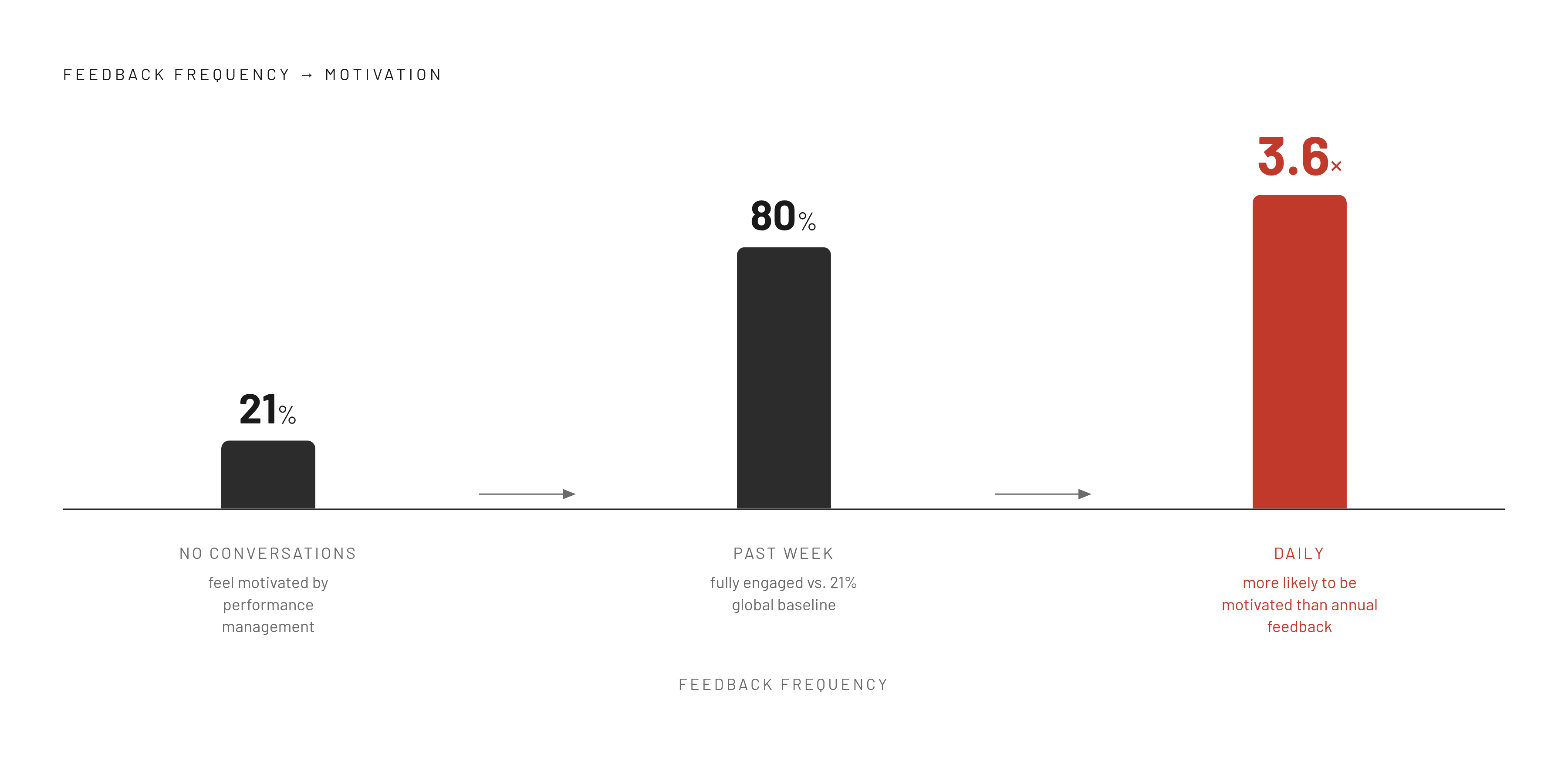
Gallup's research across 13,490 employees found that those who received meaningful feedback in the past week were 80% fully engaged, against a global baseline of just 21%. That gap isn't small, and it isn't one-time either. It compounds the more regularly feedback actually happens.
Frequency does real work on its own. Employees who get feedback daily are 3.6 times more likely to feel motivated toward outstanding work than those who hear from a manager once a year. Yet only 14% of employees strongly agree that performance reviews actually inspire them to improve. The formal review cycle, even executed well, isn't carrying the weight on its own.
McKinsey's research makes the size of that gap concrete: only 21% of employees with no development conversations felt motivated by their company's performance management process, compared to 77% among employees who got ongoing feedback and development conversations. That's not a marginal difference between two management styles. A single, isolated conversation doesn't change how a rep performs. A running dialogue does.