Distinguishing Low Skill From Low Motivation in Sales Reps
A manager's misdiagnosis of skill versus will costs six figures in preventable turnover.

Sales managers keep making the same diagnostic error: they treat a capability problem like a willpower problem, or the reverse, and the rep keeps missing quota while the manager keeps doing the wrong kind of work. Getting this wrong is a major miscalibration. A rep who improves in two weeks costs far less than one who's gone in six months, replaced at a cost that runs well into six figures.
A manager can run a technically flawless one-on-one, hit every talking point in the coaching playbook, and see zero behavior change the following week. Usually that happens because the manager coached a skill the rep already had. The rep didn't need another framework for handling objections. They needed a reason to care, or they needed someone to notice that their territory got gutted last quarter and nobody adjusted the number.
Misdiagnosis raises turnover, which is visible in the churn data. Sales rep turnover is near 35% annually, close to three times the average across other industries, and a fully loaded replacement costs somewhere between $115,000 and $150,000 per rep. The Bridge Group's Sales Development Report puts total turnover cost at 150% to 200% of the departing rep's annual on-target earnings. Misdiagnosis accelerates all of it: coach the wrong lever on a capable rep and you demoralize someone who was salvageable, while an underperformer with a real motivation problem gets to linger under a training plan that was never going to fix them.
The stakes are higher this year than last. Quota attainment fell from 52% in 2024 to 46% in a later year, a figure pulled from a substantial pool of opportunities across 3,613 companies, and 74% of B2B sales leaders now say closing deals has gotten harder. Some of that is structural: CFOs gating spend, buying committees swelling to six or ten stakeholders, cycles stretching 20% to 30% longer than they used to. But structural drag doesn't explain the whole miss, and individual diagnosis still matters. When the market is genuinely tougher, managers are more tempted to wave every underperformer through as "just the environment." Some of them are. Plenty aren't.
The skill-vs-will matrix as a starting map, not a final answer
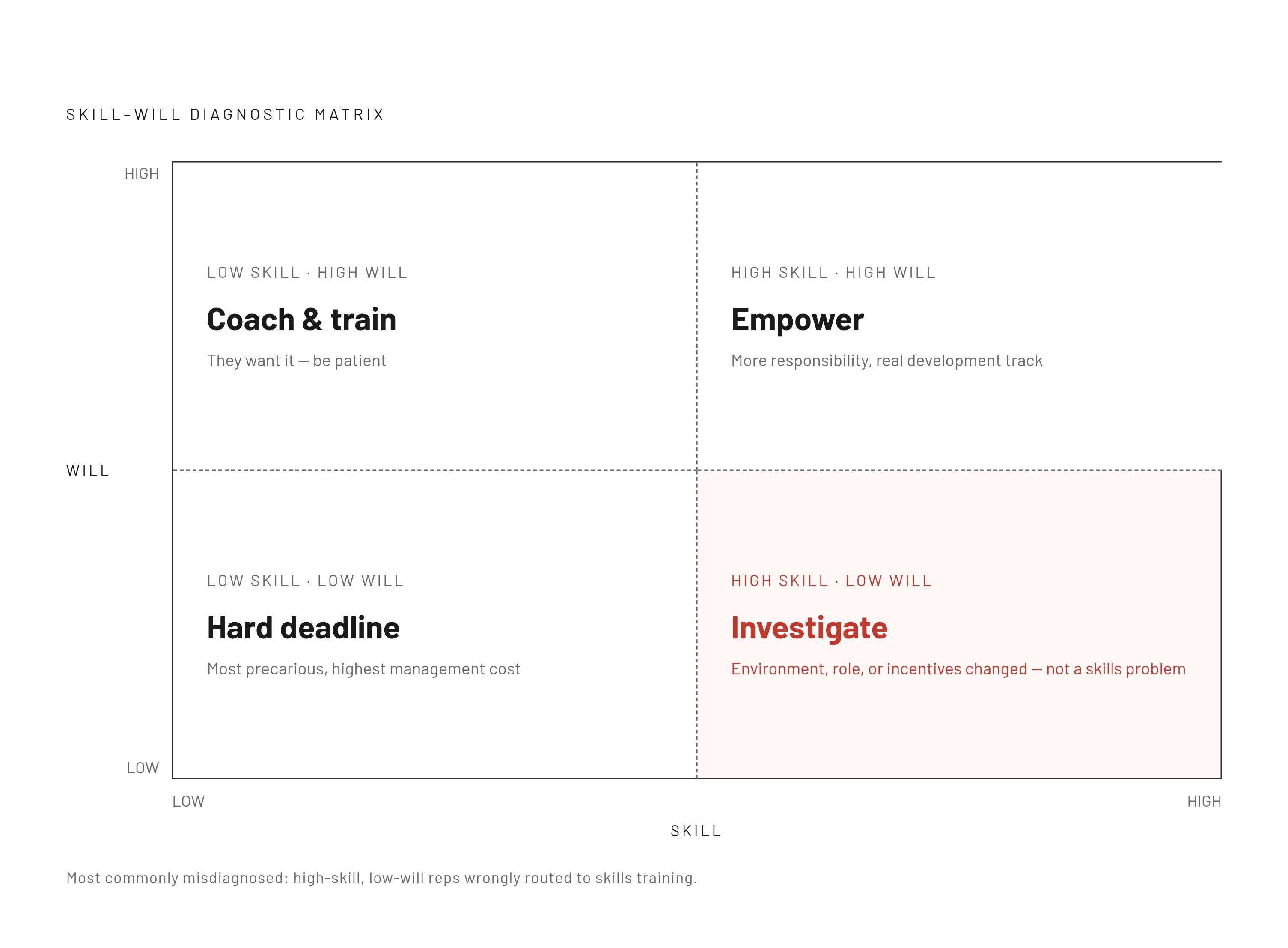
The starting framework for this diagnosis isn't new. It was refined by Max Landsberg in The Tao of Coaching and appears constantly in sales management literature because it forces a simple, disciplined split: can this person do the job, and do they want to?
Skill covers technical competence and experience, the learnable stuff. Will covers motivation, confidence, and engagement, the stuff that no amount of product training touches. Cross those two axes and four quadrants fall out. A rep high on both is performing at the top of the matrix, and the job there is to empower them with more responsibility and a real development track, not more oversight. A rep with high will but low skill is eager but undertrained: coach them, train them, and be patient, because they already want it. A rep with high skill but low will is disengaged despite capability, and the job is to find out what changed in their environment, their role, or their incentive plan that made them stop trying. A rep low on both axes is in the most precarious position, and that combination eats the most management time and usually needs a hard deadline attached to it.
The matrix earns its keep by forcing the question into two separate parts before anyone picks an intervention. Most managers skip that split entirely and go straight to a response, which is how a capable-but-disengaged rep ends up in another round of call-shadowing that changes nothing.
A third root cause the binary misses: structural and system-level gaps
Skill and will don't cover every case. Sometimes neither is the problem, since the rep can execute and the rep wants to execute, yet the system around them still produces a loss. A comp plan that rewards the wrong behavior, a sales process that creates friction at the exact stage where deals need to move fastest, messaging that stopped resonating with the market two quarters ago, a territory assignment that makes quota mathematically improbable regardless of effort. None of these are fixed by coaching or by a pep talk.
Quota design itself is a common offender. Nearly a third of sales leaders, 31%, cited unrealistic quotas as the primary reason reps missed target, which is a company-level failure wearing an individual-performance costume. Before running any one-on-one diagnosis, managers should first check whether the pattern is isolated or widespread. One rep missing is a rep problem. A whole segment, territory, or product line missing in the same way, despite different reps with different skill levels and different motivation, is a system problem, and no amount of coaching individual reps will fix a broken quota model or a pricing change nobody adjusted the target for.
Signals that point to a skill gap rather than a motivation gap
A skill gap means the rep genuinely cannot execute some specific part of the process because the technique was never taught or never landed. The rep can describe the right move in a debrief but can't produce it live, in front of a prospect, when a bad answer can cost the deal.
The common manifestations are recognizable once you're looking for them. Discovery questioning that stays surface-level and never gets to the real business problem. Objection handling that turns defensive or escalates instead of de-escalating. An inability to articulate why the product beats the alternative sitting on the prospect's other tab. Outbound sequencing that's structurally sloppy, meetings booked almost by accident rather than by a repeatable cadence.
The pipeline itself is a better diagnostic tool than any self-report a rep will give you. A rep who books first meetings consistently but can't convert them into second meetings has a discovery problem, full stop. A rep who reaches proposal stage regularly but loses disproportionately to "no decision" has a closing or urgency-creation problem. Where the deal stalls tells you more than the rep's own account of what's going wrong, because reps are often unaware of exactly where their process breaks down.
Signals that point to a motivation gap rather than a skill gap
A motivation gap looks different: the ability is there, the rep has proven it before, but the consistency isn't. Capability exists in the record. Effort or engagement is inconsistent in the present.
Context is the differentiator that matters most here. A rep who nails the role-play in training but freezes on the actual call has a motivation or mindset problem, not a skill problem, because the skill clearly exists somewhere. A rep who performs well whenever a manager is shadowing the call but reverts the moment they're alone is showing you that discretionary effort, the work nobody can mandate, has gone missing.
Discretionary effort is the cleanest signal available. It's the gap between what a job description requires and what a rep chooses to do beyond it, and that gap can't be forced into existence with a policy. Its disappearance is one of the most reliable predictors of declining engagement. Watch for a steady drop in activity metrics, calls, emails, meetings booked, that isn't explained by a territory change or a new product launch. Watch for more absenteeism or lateness, which usually tracks with a broader drop in accountability. Watch for a rep who used to show up in team chat or at the Friday call and has quietly stopped, because withdrawal from peer connection is often the earliest visible sign, well before the pipeline numbers confirm it.
How to run the diagnostic conversation
The infrastructure for good diagnosis mostly doesn't exist. Ninety-four percent of managers say regular coaching is part of their process, yet 37% of reps report rarely or never getting personalized feedback, and 53% get coached quarterly or less. Managers most commonly point to time constraints as the reason. Only 26% of buyers rate salespeople as good listeners, a gap that traces partly back to managers who were never handed a real framework for what "better" listening looks like, so there was nothing concrete to coach toward. It's telling that 60.9% of Chief Sales Officers now rank improving sales manager effectiveness as their single top priority. Management capability is the bottleneck. It's management capability.
Pipeline review has to come before the individual conversation, not after it. Where a deal consistently stalls tells a manager which capability is actually missing before any one-on-one begins, and skipping that step in favor of a gut-feel conversation is how managers land in the wrong quadrant before they've even opened their mouth.
The debrief itself doesn't need to be elaborate. Three questions, asked before or after a call, reveal the split fast. "What's your goal for this call?" shows whether the rep walked in with intent or just showed up. "What's your plan?" shows whether they can structure an approach or are improvising in real time. "What does success look like?" shows whether they understand the outcome they're chasing or are just going through the motions. A rep who answers all three clearly and still underperforms on the actual call is showing a skill-execution gap, the plan was sound but the delivery broke down under pressure. A rep who answers vaguely, or seems checked out while answering, is showing something closer to a motivation or clarity problem.
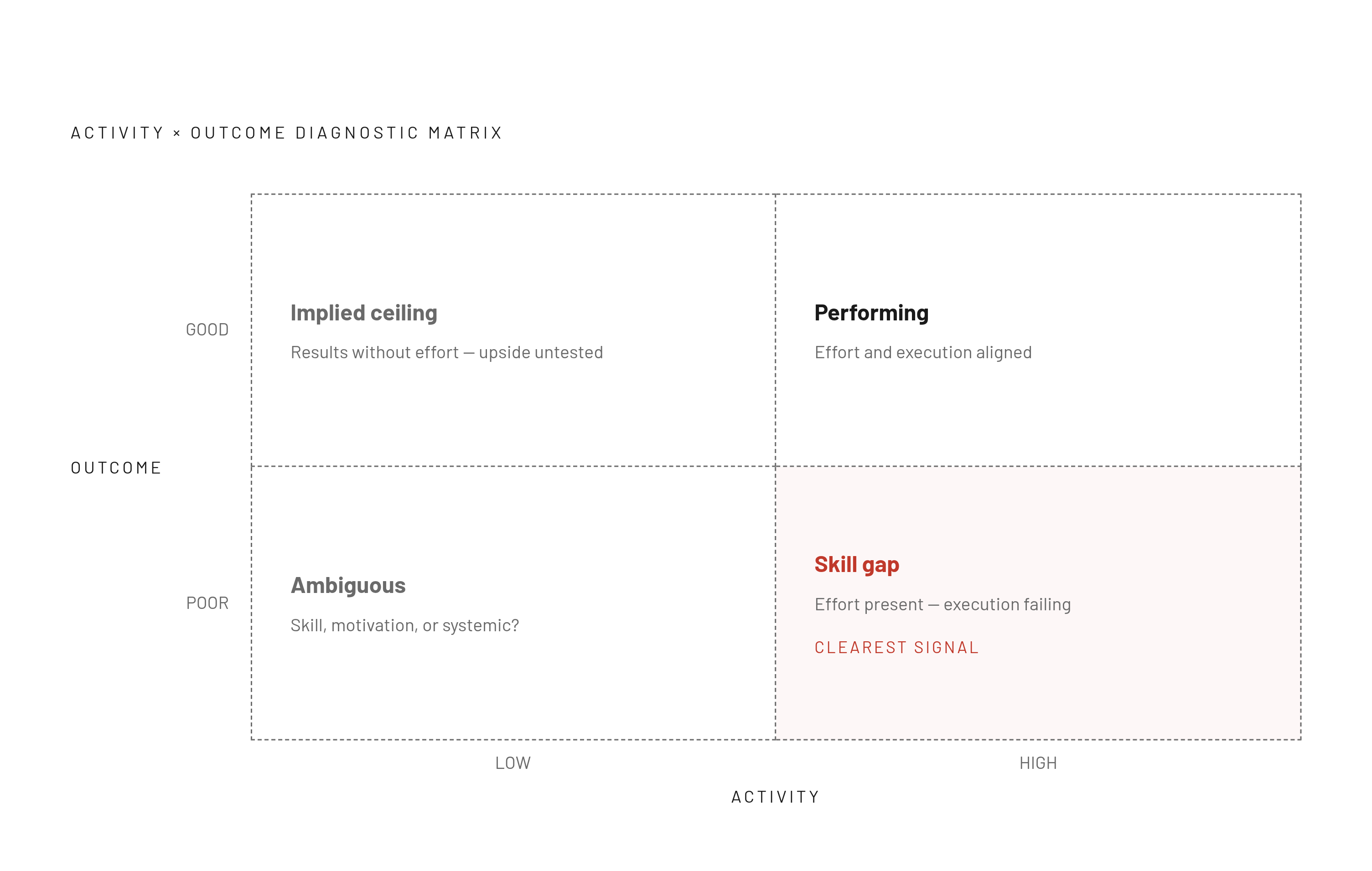
Activity and outcome metrics only mean something read together. High activity paired with poor results points to a skill gap, since the effort is clearly present and the execution isn't. Low activity paired with clear capability points to motivation or engagement. Low activity paired with poor results is the ambiguous case, and it could be either, or it could be systemic; the conversation has to happen rather than getting skipped in favor of a metrics dashboard.
The wiring mismatch argument: when neither coaching nor motivation fixes it
A stronger claim is that quota miss is almost never, at root, a motivation problem. Across most cases, the real cause is one of three things: a rep wired for one kind of selling who's been placed in a role that demands another kind entirely, a skill gap that was never properly diagnosed or coached in the first place, or an environment so structurally broken that no individual effort was ever going to close the gap.
Motivation is a symptom. Wiring mismatch is the disease. A rep who looks disengaged hasn't necessarily stopped caring. More often, the demands of the seat don't match how that person is built to sell, and the disengagement is what a mismatch looks like from the outside.
The pattern is recognizable. A rep who thrives managing existing accounts, nurturing relationships over quarters, gets dropped into new-business hunting and can't generate pipeline from cold outreach because the motion is foreign to how they operate. Or the reverse: a rep with strong technical depth and real relationship-building instinct gets placed in a transactional, high-velocity environment where speed outpaces depth, and the fit just isn't there. No amount of process coaching changes a rep's natural motion in a deal, because the wiring, not the will, is the ceiling.
The trap most managers fall into is running coaching on what's actually a wiring problem, because coaching feels more humane than admitting the seat is wrong for the person in it. That instinct is understandable. It's also expensive, costing three to six months of coaching cycles that produce no measurable improvement, a rep who grows more frustrated by the month, and a team that absorbs the drag while everyone waits for a diagnosis that should have been made at the start.