Rep Behavior Changes When Manager Is Present on Calls
Managers mistake performance changes for behavior change when they observe calls live.

What changes on the call, and what just looks like it does
A rep's behavior changes the moment a manager joins, and it has almost nothing to do with skill. It's a documented psychological response to being watched, first named nearly a century ago, and it's the reason most call observation produces a distortion instead of a diagnosis. Managers who treat what they see on a monitored call as the truth about a rep are, more often than not, grading a performance rather than a pattern.
The name for it is the Hawthorne effect, drawn from studies at Western Electric's Hawthorne Works plant beginning in the 1920s. Workers there increased output during the observation periods, though researchers have since debated how much awareness of being watched, versus other factors, actually drove the change. The researchers who led the work found the effect real, though subsequent scholarship has debated both its causes and its magnitude. What mattered wasn't motivation or newfound competence. It was awareness. The context shifted, and behavior followed it.
Sales is unusually fertile ground for this because the rep controls almost everything visible on a call, talk time, pacing, energy, structure, while the manager controls the stakes of the room just by being in it. The visible effects run positive on the surface: reps talk to more prospects, calls tighten up, scripts get followed more closely. Observation-based studies show sales activity shifting once reps are told they'll be evaluated, even when no training happened beforehand. Everything looks like coaching worked.
The reward pattern managers apply is the mechanism at work here: managers reward whatever is most visible in a call, and that reward pattern is what produces the distortion. Managers reward whatever is most visible in a call, and that reward pattern is what produces the distortion. Gong's data across large call samples puts the average talk-to-listen ratio at roughly 60 percent talking to 40 percent listening. When a manager sits in, reps lean harder into whatever shows, talking more, sounding more in command, instead of sharpening what actually separates winners from losers: consistency. Gong found that low performers see their talk time swing by about 10 percent between deals they win and deals they lose, while high performers hold steady no matter the outcome. A manager watching live can see that a rep went quiet when price came up. What that manager cannot see is why, and that single visible moment could be caused by half a dozen different underlying issues.
The effect cuts the other way too, often for different reps. Research on sales call anxiety has tied situational factors during a live call to measurable anxiety responses, and that anxiety correlates with over-talking, physical tells like trembling hands, and defensive habits such as unnecessary apologizing, all of which hurt how a buyer reads the rep. A manager sitting in can trigger exactly this, particularly for newer reps or the solid-but-unproven middle of a team. Some reps rise to the audience. Others freeze, or start treating the call like a deposition.
The speed of behavior fade after the manager leaves
One documented case makes the shelf life of this effect concrete: a sales group saw a 12 percent increase during an observation period, only to see performance return to its prior level shortly after. Nothing had fundamentally changed about how the team sold. What had changed was attention, and once the attention left, so did the gain.
That case fits a broader pattern rather than standing alone. Research on the Hawthorne effect consistently shows a short shelf life: the gain observed during monitoring is a temporary condition tied to being watched. It's a temporary condition the monitoring itself creates, and it collapses on schedule once the monitoring stops.
A common mistake is treating a performance bump during an observation period as proof that a new script, policy, or coaching intervention worked. A common mistake is treating a performance bump during an observation period as proof that a new script, policy, or coaching intervention worked. The real test comes six weeks later, once monitoring turns routine and the rep's awareness of being watched fades along with everyone else's. Used alone, manager-present observation produces a snapshot, and mistaking it for a baseline leads an org to double down on something that never actually changed anyone's behavior.
The gap between how much coaching managers think they give and how much reps experience
Gallup's study of 2,729 managers and 12,710 individual contributors found that 50 percent of managers say they deliver feedback weekly, but only 20 percent of employees say they receive it. That's a striking perception gap, and it means a lot of what managers count as coaching never registers as coaching once it reaches the rep.
The trend line is worsening. Reps rating their coaching below average sat at 29 percent in 2025; that number jumped to 45 percent in 2026. Meanwhile 64 percent of leaders believe they're spending more time coaching than ever. Both things are apparently true at once, which says less about effort and more about what's actually happening in these sessions.
Much of it is pipeline review wearing coaching's clothes. Nobody's talking about a specific call, a specific line that landed badly, or the objection that keeps coming up on every discovery call this quarter. Pipeline review is a management activity. Coaching is a skill-development activity. They look identical from the manager's side of the desk and feel completely different from the rep's side. And when actual coaching does happen, it rarely lands on the highest-leverage skills: objection handling gets just 2 percent of training focus, despite having the highest performance differential among the skills tracked.
Bandwidth explains part of this, though not all of it. The average manager now oversees somewhere between 9 and 12 direct reports, a load sometimes called the "megamanager" problem. McKinsey's research on frontline management found managers spend 30 to 60 percent of their time on administrative work before coaching even enters the picture, and HubSpot and the Sales Management Association put a finer point on it: the average manager spends just 8 percent of total workload actually coaching direct reports. The math doesn't leave much room for a session that moves a skill.
What distinguishes live call observation from recorded call review
Live silent monitoring lets a manager listen to a call in real time without alerting the customer or breaking the flow, which sets it apart from a recording pulled up after the fact. It earns its keep during onboarding, when a manager needs to know what's happening on a new hire's calls this week, not last month's. But the instant a rep knows a manager is listening live, the Hawthorne effect fires. Live observation is the highest-stakes, highest-distortion version of this entire practice, and managers who lean on it as their main coaching tool are mostly coaching the performance.
The shadow-call principle exists because of this exact risk: the manager does not intervene during the call, not even when the rep makes a visible, costly error. The debrief happens after, never during. Stepping in mid-call might rescue that one deal, but it robs the rep of the only mechanism that actually builds skill, which is the discomfort of handling it alone and then examining what happened afterward.
Recorded review runs on the opposite failure mode. Frontline managers can only sample a small fraction of recorded calls, so a growing archive sitting largely untouched in a CRM doesn't move behavior on its own. Recordings show what was said. They don't show what should have been said instead, which makes them diagnostic at best and inert without a person turning the diagnosis into action. Left alone too long, recordings pick up a grim reputation of their own: reps start to believe a recording only gets pulled up to build a case against them, which breeds defensiveness instead of the openness observation is supposed to produce.
Both methods share the same floor. Data, whether from a live listen or an archived recording, rarely produces lasting change without a coach actively working the material with the rep in the room. The sales orgs that get real value from either method share one habit: every coaching session ties back to one real deal or one real recorded moment. Telling a rep to "be more consultative" moves nothing. Pointing to the exact moment a prospect went cold moves everything.
How AI conversation intelligence changes what managers can see without being in the room
Conversation intelligence tools solve a scarcity problem live and recorded observation never could touch. Instead of a manager sampling a handful of calls a week, every call becomes reviewable, and the rep can no longer perform for the one call that gets watched while the other ninety slide by unseen.
These platforms surface patterns that used to require a manager's ear and a fair amount of luck to catch. Gong's data shows lost deals feature noticeably longer seller monologues, a sign buyers disengage once a rep starts dominating the airtime. Its 2025 analysis found low-performing reps average 54 percent talk time on deals they win versus 64 percent on deals they lose, while high performers hold their ratio steady regardless of outcome, exactly the kind of drift a tool flags before a manager would ever catch it by ear. Question volume tells a similar story: reps who lost deals asked around 20 questions on average, against 15 to 16 for reps who won, which suggests firing off more questions stops helping past a certain point.
A handful of named platforms operate in this space, each with its own angle. Gong.io records, transcribes, and analyzes sales calls with AI, and its research gets cited widely for exactly this kind of talk-time and question-pattern analysis. Clari brings deal health scores and engagement signals into revenue operations workflows. Salesforce Sales Cloud, paired with Einstein AI, folds predictive pipeline insight and rep performance data into the CRM reps already live in. HubSpot Sales Hub builds call intelligence directly into its own CRM. ZoomInfo, through its Copilot AI agents, surfaces account context and next-best actions right where sellers are working.
The behavioral consequence runs deeper than "more data." When every call gets measured instead of just the sampled few, the Hawthorne distortion has nowhere left to hide. A rep can put on a performance for the one call a manager happens to join. Putting on a performance for a hundred calls a week, indefinitely, isn't something anyone can sustain. What the data reflects, eventually, is the rep's actual pattern.
What the research says produces lasting behavior change after a call observation
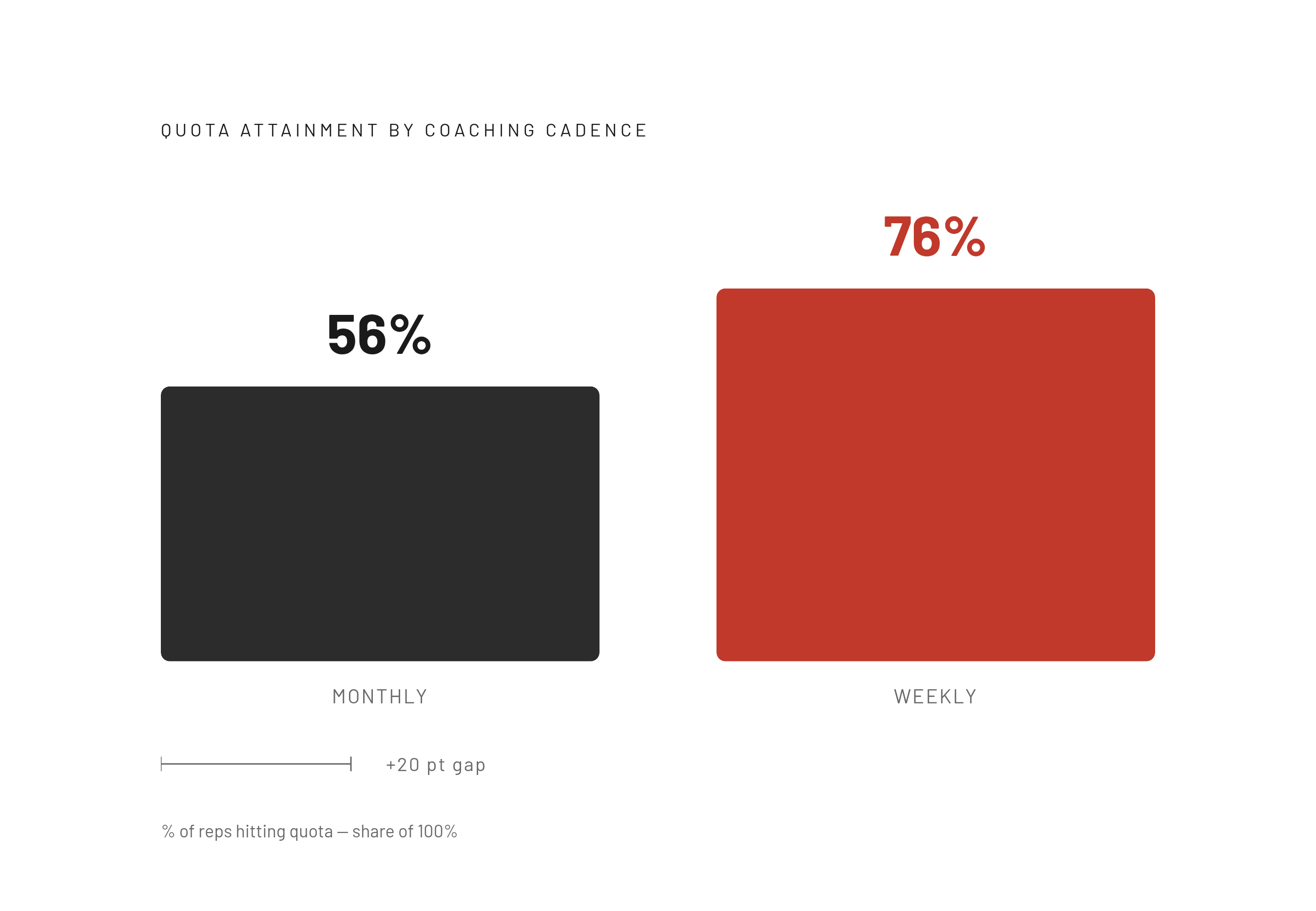
Frequency is the lever managers can actually pull, and the data on it isn't close. Teams coached weekly see 76 percent of reps hit quota, a number that drops to 56 percent under monthly coaching. Harvard Business Review's sales productivity study found that moving from monthly to weekly cadence produced a 28 percent lift in quota attainment for the middle 60 percent of reps, the group that isn't already a star and isn't already a lost cause, exactly where coaching has room to matter.
Cadence isn't the whole answer, though. Who does the talking in the room matters just as much. When a manager spots the problem, hands the rep the fix, and the rep nods along, no insight actually got generated on the rep's side of the table. Research on adult learning consistently finds self-generated insight sticks in a way manager-delivered advice doesn't. Gartner's Chief Sales Officer research found top-performing organizations run coaching sessions at roughly a 70/30 ratio, the rep talking 70 percent of the time and the manager 30. None of it holds without repetition, either: training delivered without follow-up coaching loses roughly 87 percent of its impact within 30 days, a decay rate consistent with the century-old Ebbinghaus forgetting curve.
Anchoring feedback to something concrete carries its own separate lift. Roughly half of high-performing companies use a formal competency framework to structure feedback, and Highspot's research found teams tying coaching to specific real actions, not abstractions, are 23 percent more likely to improve quota attainment. Coaching anchored to specific behaviors, how a rep runs discovery or handles an objection, tends to connect more directly to outcomes: reps who stick closely to a defined discovery methodology win at roughly twice the rate of those who score low on the same measure.
None of this works if the rep experiences the exercise as a threat instead of a genuine shot at getting better. Research on sales performance anxiety consistently finds that reframing observation, backed by real manager support and a calmer, less defensive posture from the rep, lowers anxiety and lifts performance in a measurable way. That circles back to the shadow-call principle: the manager who resists jumping in mid-call, and saves every correction for the debrief, is the one giving the rep room to actually own the outcome. That ownership, more than the observation itself, is what turns a call review into something that outlasts the manager leaving the room.
Sources
- How to Coach Sales Reps Effectively in 2026: A Sales Manager's Playbook
- Mastering the talk-to-listen ratio in sales calls
- 10 Ways AI is Changing the Role of Sales Reps — For the Better
- The sales manager’s blind spot: why call reviews aren’t enough anymore - RepsMate - make interactions count
- How do sales managers coach reps without sitting in on every call?
- isixsigma.com
- mysalescoach.com
- cuepitch.com